


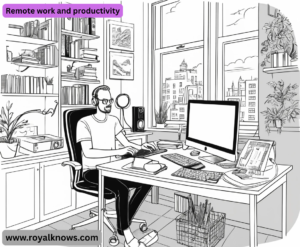
Remote work and productivity Remote work has become a permanent feature of the modern workforce, with many companies adopting hybrid or fully remote models. Here’s a breakdown of the key factors affecting productivity in remote work and how to optimize it.
Benefits of Remote Work on Productivity
- Flexibility & Autonomy – Employees can work during their most productive hours.
- Reduced Commute Stress – More time and energy for focused work.
- Fewer Office Distractions – Less noise and interruptions compared to open offices.
- Access to Global Talent – Companies can hire the best candidates regardless of location.
Challenges to Productivity in Remote Work
- Isolation & Loneliness – Lack of social interaction can reduce motivation.
- Blurred Work-Life Boundaries – Difficulty disconnecting leads to burnout.
- Communication Barriers – Delays in responses and misunderstandings.
- Home Distractions – Family, chores, or unstructured environments can disrupt focus.
Strategies to Boost Remote Productivity
For Employees:
- Set a Routine – Stick to consistent work hours and take structured breaks.
- Design a Dedicated Workspace – Minimize distractions and separate work from personal life.
- Use Time Management Techniques – Pomodoro, time blocking, or task prioritization (e.g., Eisenhower Matrix).
- Leverage Productivity Tools –
- Task Management: Trello, Asana, Notion
- Communication: Slack, Microsoft Teams
- Focus Apps: Forest, Focus@Will
For Employers:
- Set Clear Expectations – Define deliverables, deadlines, and communication protocols.
- Promote Asynchronous Work – Reduce meeting overload with tools like Loom (video updates) or Docs.
- Encourage Regular Check-ins – Weekly 1:1s to align on goals and address concerns.
- Invest in Well-being – Offer mental health support, flexible hours, and virtual team-building activities.
The Future of Remote Productivity
- AI & Automation – Tools like ChatGPT and Zapier streamline repetitive tasks.
- Hybrid Work Models – Balancing office and remote work for optimal collaboration.
- Outcome-Based Performance – Shifting from “hours worked” to “results delivered.”
The Psychology of Remote Productivity
A. Motivation & Discipline
- Intrinsic vs. Extrinsic Motivation – Remote workers need strong self-discipline since external supervision is minimal.
- The “Two-Minute Rule” – If a task takes less than 2 minutes, do it immediately (prevents procrastination).
- The Zeigarnik Effect – Unfinished tasks stay on our minds; breaking work into smaller chunks keeps momentum.
B. Avoiding Burnout
- Digital Detox – Set “no-notification” hours to recharge.
- The 20-20-20 Rule – Every 20 minutes, look at something 20 feet away for 20 seconds (reduces eye strain).
- Microbreaks – 5-minute breaks every hour improve focus (studies show a 13% productivity boost).
Advanced Productivity Techniques
A. Deep Work vs. Shallow Work (Cal Newport)
- Deep Work (2-4 hrs/day): High-concentration tasks (coding, writing, strategy).
- Shallow Work: Administrative tasks (emails, meetings).
B. Time Blocking (Elon Musk’s Method)
- 9:00-10:30 AM – Deep work (no meetings)
- 10:30-11:00 AM – Emails & Slack
- 11:00-12:00 PM – Team sync call
Managing Remote Teams for Maximum Productivity
A. Async-First Culture (Avoiding Meeting Overload)
- Default to written updates (Notion, Docs, Loom).
- Meetings only for decisions, not updates.
- Use “No-Meeting Days” (e.g., Wednesdays for deep work).
B. Measuring Productivity (Not Just Hours Worked)
- OKRs (Objectives & Key Results) – Track outcomes, not activity.
- Weekly Check-ins – “What did you accomplish? What’s blocking you?”
C. Preventing Isolation & Boosting Morale
- Virtual Coffee Chats – Randomly paired team catch-ups.
- Gamification – Reward systems for milestones (e.g., bonus PTO for hitting goals).
- Wellness Stipends – Budget for home office upgrades or gym memberships.
The Future of Remote Work Productivity
A. AI & Automation
- Automated Workflows (Zapier, Make.com) to eliminate repetitive tasks.
B. Hybrid Work Evolutio
- “Office for Collaboration, Home for Focus” – Structured hybrid policies.
- VR Workspaces – Meta Horizon Workrooms, Apple Vision Pro for immersive meetings.
C. Results-Only Work Environment (ROWE)
- Employees evaluated on output, not hours logged.
- Companies like GitLab and Basecamp already use this model.
Neuroscience of Remote Productivity
A. Brain Chemistry & Focus
- Dopamine & Task Completion
- Breaking work into micro-tasks creates frequent “reward moments” (dopamine hits) that sustain motivation.
- Tool: Apps like Habitica gamify to-do lists for dopamine-driven productivity.
Ultradian Rhythns
- The brain operates in 90-minute focus cycles. Working in sync with these (e.g., 90 mins on → 20 mins off) boosts efficiency.
B. The “Attention Residue” Effect
- Switching tasks leaves cognitive “leftover” thoughts from the previous task, reducing performance by up to 40%.
- Fix: Dedicate blocks to single tasks (e.g., “9-10 AM: Only client proposals”).
Industry-Specific Remote Productivity Hacks
A. Software Developers
- Flow State Triggers
- Use dark mode IDEs (e.g., VS Code) and binaural beats playlists to enter deep focus.
- Tool: Warp Terminal (AI-powered dev environment) automates repetitive commands.
Async Standups
- Replace daily meetings with Geekbot (Slack bot that collects updates automatically).
B. Creative Professionals (Designers, Writ
- “Creative Sprints”
- 25-minute bursts of work + 5-minute doodling/walking breaks to prevent creative burnout.
- Tool: Milanote for visual brainstorming.
C. Sales & Client-Facing Roles
- AI-Powered Call Prep
- Tools like Gong analyze past calls to suggest talking points.
- Hack: Pre-record Loom videos for personalized follow-ups at scale.
The Dark Side of Remote Work: Countermeasures
A. Digital Presenteeism
- Problem: Employees stay “online” to appear busy, leading to burnout.
- Fix: Output-based KPIs (e.g., “Close 5 deals/week” vs. “Be online 9-5”).
B. Proximity Bias
- Remote workers get passed over for promotions because they’re “out of sight.”
- Fix: Managers must document contributions objectively (use 15Five for performance tracking).
C. Timezone Chaos
- Strategy:
- Core Hours Overlap (e.g., 10 AM-12 PM EST for global teams).
- Async Documentation (Record meetings with Fireflies.ai for absent team members).
Cutting-Edge Productivity Experiments
A. Polyphasic Sleep for Remote Workers
- Some high performers adopt Uberman sleep (20-minute naps every 4 hours) to maximize awake hours.
- Caution: Not sustainable for most—try biphasic sleep (6-hour night + 20-min nap) instead.
B. Biohacking for Focus
- Nootropics: Substances like L-theanine + caffeine improve focus without jitters.
- CES Devices: Transcranial direct-current stimulation (tDCS) headsets claim to boost cognition.
C. “No-Light” Workdays
- Some remote workers report higher focus by working in pitch darkness (monitor backlight only).
Case Studies: Extreme Remote Productivity
A. GitLab (Fully Remote, 2,000+ Employees)
- Async Handbook: 5,000-page public doc detailing all processes.
- No-Meeting Wednesdays: Mandatory focus day.
B. Doist (Maker of Todoist)
- 4-Day Workweeks: 32-hour weeks with full pay—productivity increased by 20%.
Your Personalized Productivity Audit
Answer these to spot weaknesses:
- Do you track deep work hours? (If <2 hrs/day, recalibrate priorities.)
- What’s your #1 distraction? (e.g., Slack → mute notifications 4 hrs/day.)
- When do you feel most energized? (Align critical tasks to this time.)
The Neurobiology of Peak Remote Performance
The Cognitive Architecture of Focus
- Prefrontal Cortex & Deep Work: The brain’s “CEO” requires 23 minutes to fully engage in complex tasks after an interruption (University of California study).
- Dopamine Loops: Micro-task completion triggers reward cycles. Pro Tip: Use Beeminder (anti-procrastination app with monetary stakes).
Chronotype Optimization
- Lions (Morning): Schedule analytical work before noon
- Wolves (Evening): Save creative tasks for post-7 PM
- Tool: Chronotype Quiz by Sleep Foundation
The Circadian Trough
- 2-4 PM biological slump: Use this for administrative tasks, not decision-making.
- Hack: 10-minute NSDR (Non-Sleep Deep Rest) session resets focus better than caffeine.
 xentro6@gmail.com