


Food and Public Distribution Of course. The term “Food and Public Distribution” refers to a critical government function that ensures food security for its citizens, particularly the most vulnerable sections of society. It involves a complex system of managing food procurement, storage, and distribution, often at subsidized prices. Here is a comprehensive breakdown of what it entails, its key components, objectives, and associated challenges.
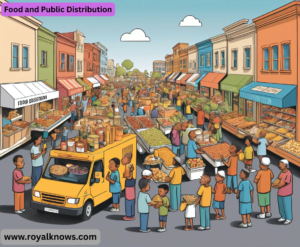
Core Objective
- The primary objective of any Food and Public Distribution system is to ensure national food security. This is achieved by:
- Stabilizing Food Prices: Preventing extreme fluctuations that hurt both consumers and farmers.
- Providing Access to Food: Making essential food grains available to low-income households at affordable prices.
- Supporting Farmers: Providing a guaranteed market and minimum support price for their produce to encourage production and ensure income stability.
Key Components of the System
Procurement
- The government purchases food grains (like wheat, rice, and sometimes pulses) directly from farmers at a pre-announced Minimum Support Price (MSP).
- This usually happens through designated agencies (e.g., the Food Corporation of India (FCI) in India).
- Purpose: To build up buffer stocks for the PDS and to protect farmers from distress sales when market prices are low.
Storage
- The procured food grains are stored in a vast network of government-owned and hired warehouses (e.g., silos, godowns).
- Proper scientific storage is crucial to prevent massive losses due to pests, moisture, and spoilage.
- Purpose: To maintain strategic food reserves (buffer stocks) for use in the PDS and to mitigate shortages during droughts, floods, or other emergencies.
Distribution
- This is the final leg—getting the food from the warehouses to the people.
- It operates through a network of Fair Price Shops (FPS) or ration shops, which are licensed to distribute subsidized food grains and other essentials (like sugar, kerosene) to eligible beneficiaries.
- Beneficiaries are identified based on socioeconomic criteria and are often issued ration cards.
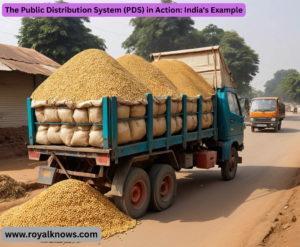
The Public Distribution System (PDS) in Action: India’s Example
- Key Agency: The Food Corporation of India (FCI) handles procurement, storage, and interstate transportation.
- Flagship Program: The National Food Security Act (NFSA), 2013
- It legally entitles up to 75% of the rural population and 50% of the urban population to receive subsidized food grains.
- Subsidy: Provides 5 kg of food grains per person per month at highly subsidized prices:
- Rice: ₹3/kg (~$0.04)
- Wheat: ₹2/kg (~$0.02)
- Coarse grains: ₹1/kg (~$0.01)
- Ration Cards: The system is moving from physical ration cards to digital Aadhaar-linked biometric authentication at Fair Price Shops to reduce leakage and ensure transparency.
Major Challenges
- Despite its noble goals, Food and Public Distribution systems face significant challenges:
- Leakage and Diversion: Food grains meant for the poor are often diverted to the open market due to corruption, fake ration cards, and transportation losses.
- Identification of Beneficiaries: Incorrectly identifying the truly needy leads to inclusion errors (non-needy receiving benefits) and exclusion errors (needy being left out).
- Storage and Food Wastage: Inadequate storage infrastructure leads to massive post-harvest losses, estimated in millions of tonnes annually in large systems like India’s.
- Logistical Inefficiencies: The supply chain from farmer to FPS can be slow and cumbersome, leading to delays and spoilage.
- Financial Burden: The subsidy bill for procuring and distributing food is enormous and places a heavy strain on the government’s finances.
- Market Distortion: Large-scale government procurement can sometimes distort agricultural markets, discouraging crop diversification away from staple grains like wheat and rice.
Recent Reforms and Innovations
- To address these challenges, governments are implementing reforms:
- Digitization and Aadhaar Linking: Using biometrics to authenticate beneficiaries at the point of sale to eliminate ghost cards and duplicate cards.
- Direct Benefit Transfer (DBT): Instead of physical grain, transferring the cash equivalent of the subsidy directly into the beneficiary’s bank account. This allows them to buy food from any shop and reduces leakage. (Pilot programs are ongoing in various forms).
- Online Ration Card Management: Transparent online systems for application, tracking, and grievance redressal.
- GPS Tracking of Trucks: Monitoring the transportation of food grains to prevent diversion en route.
- Building Modern Silos: Investing in modern storage infrastructure to reduce wastage.
. The Buffer Stock Theory:
- Food and Public Distribution The system acts as a massive shock absorber for the food economy.
- When production is high & market prices fall: Government procurement increases, mopping up excess supply and ensuring the MSP for farmers. This prevents a price crash.
- When production is low & market prices rise: The government releases grains from its buffer stock into the open market through OMSS (Open Market Sale Scheme) or increases allocation to the PDS. This increases supply and cools down prices.
- This cyclical process is crucial for maintaining price stability, a key goal of macroeconomic policy.
The Subsary Structure:
- The term “subsidy” in this context has two main components:
- Freight Subsidy: The cost of transporting food grains from surplus states (e.g., Punjab, Haryana) to deficit states (e.g., Northeastern states, Jharkhand) is borne by the central government to ensure uniform pricing.
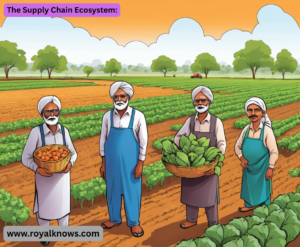
The Supply Chain Ecosystem:
A vast network of actors is involved:
- Farmers: The primary producers.
- Arhatiyas (Commission Agents): In some systems (like India’s), they act as intermediaries between farmers and procurement agencies, facilitating aggregation, weighing, and payment (for a commission).
- Procurement Agencies: e.g., FCI, NAFED, state government corporations.
- Storage Agencies: FCI, Central Warehouse Corporation (CWC), State Warehouse Corporations (SWCs), and private godowns.
- Transporters: Rail and road networks are the lifeline of the system.
- State Governments: They are responsible for identifying beneficiaries, operating the Fair Price Shops, and last-mile distribution within the state.
- Fair Price Shop (FPS) Owners: The final link, who are reimbursed a commission for their services.
Global Perspectives
- While India’s PDS is one of the largest, many countries have similar programs tailored to their needs:
- United States: The Supplemental Nutrition Assistance Program (SNAP)
- Model: Pure Direct Benefit Transfer (DBT). Eligible low-income individuals receive an Electronic Benefit Transfer (EBT) card, which works like a debit card to buy eligible food items at authorized retailers.
- Focus: Consumer choice and bolstering the retail food economy.
- Brazil: The Zero Hunger Program / Bolsa Família
- Model: A conditional cash transfer program. Families receive financial aid conditional on children attending school and getting vaccinations.
- Focus: Tackling hunger while also breaking the cycle of poverty through investment in human capital (health and education).
Egypt: Bread Subsidy Program
- Model: A universal subsidy on baladi (flatbread). Bakeries are provided with subsidized wheat and flour to produce and sell bread at a fixed, very low price.
- Focus: Providing a basic caloric staple to prevent social unrest, as bread is a central part of the diet.
- These models highlight the spectrum of approaches: In-Kind transfers (India, Egypt), Voucher/Cash Systems (USA), and Conditional Cash Transfers (Brazil).
Critical Debates and Future Directions
- The system is constantly evolving amid intense policy debates:
The MSP Debate:
- Pro: MSP is essential for incentivizing production, ensuring national food grain sufficiency, and supporting farmer incomes.
- Con: It promotes a water-intensive wheat-rice monoculture, primarily benefiting farmers in a few surplus states, and discourages crop diversification. Finding a balance is a major policy challenge.
Cash Transfer vs. In-Kind Distribution:
- Arguments against Cash (For In-Kind): Protects against inflation (the value of cash may erode, but 5 kg of rice remains 5 kg of rice), ensures food is actually spent on food (especially in households with male bias in spending), and supports the government’s procurement and price support operations.
Nutritional Security vs. Food Security:
- The current system focuses on caloric security (wheat, rice). There’s a growing push to move towards nutritional security by diversifying the food basket to include nutritious items like pulses, millets, oils, and fortified foods.
One Nation, One Ration Card (ONORC):
- A transformative reform in India that allows portability. Migrant workers can now access their subsidized food grains from any Fair Price Shop anywhere in the country using their same ration card. This is a huge step for social justice and supporting labor mobility.
Integration with Technology:
The future lies in end-to-end digitization:
- AI & Predictive Analytics: To forecast crop production, optimize procurement, and manage buffer stock levels more efficiently.
- Blockchain: To create a tamper-proof ledger for the entire supply chain, from farmer to FPS, ensuring total transparency and traceability.
- IoT Sensors: In storage godowns to monitor temperature and humidity in real-time to prevent spoilage.
 xentro6@gmail.com