


Food Reviews Of course! Food reviews are a huge and diverse topic. They can be a simple star rating, a detailed blog post, or a viral TikTok video. Here’s a comprehensive guide to understanding, reading, and writing effective food reviews.
How to Read Food Reviews Critically
Not all reviews are created equal. Here’s how to separate the useful insights from the noise:
- Look for Details, Not Just Adjectives: A review that says “The pasta was amazing” is less helpful than one that says “The pappardelle was perfectly al dente, coated in a rich, slow-cooked wild boar ragu that was deeply savory with a hint of orange zest.”
- Consider the Reviewer’s Taste: Does the reviewer consistently praise the kinds of foods you also like? If they hate spicy food and panned a Szechuan restaurant for being too spicy, that might not be a useful data point for you.
- Check the Date: Restaurants change. A review from 2019 might be irrelevant if the chef, menu, or ownership has changed since then.
- Read Between the Lines of Negative Reviews: Sometimes a negative review reveals a lot. “The service was slow because the place was packed on a Saturday night” tells you it’s popular and you might need a reservation. “The burger was too gourmet for me” might mean it’s actually innovative.
- Beware of Extreme Outliers: Both 5-star and 1-star reviews can be emotional reactions (either ecstatic or furious).
How to Write a Helpful Food Review
Your review can help both future customers and the restaurant itself. Here’s what to include:
The Essential Structure:
- Overall Rating: (e.g., 4/5 stars, 8/10)
- One-Sentence Summary: Your quick take. “A fantastic new neighborhood bistro with incredible pasta but uncomfort loud dining room.”
The Dishes (The Most Important Part):
- Name the dishes you tried.
- Describe them: “The roasted cauliflower appetizer was crispy and flavorful with a tangy yogurt sauce and a sprinkle of za’atar.”
- Give your opinion: “The steak was cooked perfectly but underseasoned.”
Service & Atmosphere:
- Was the service attentive, slow, friendly, knowledgeable?
- Describe the vibe: romantic, casual, family-friendly, loud, quiet?
- Value for Money: Was the quality and portion size worth the price?
- Conclusion: Would you go back? Who would you recommend it to (e.g., great for dates, groups, families)?
Pro-Tips for Writing:
- Be Specific: Instead of “good pizza,” say “thin, crispy crust with a slightly charred edge and a bright, acidic tomato sauce.”
- Be Fair: If your food was cold but the manager comped it and was apologetic, mention both the problem and the resolution.
- Be Objective When Possible: Differentiate between “This burger was overcooked” (objective) and “I don’t like blue cheese” (subjective). It’s okay to state preferences, but frame them as such.
- Include a Photo! A picture is worth a thousand words.
Examples of Food Reviews (Good vs. Less Helpful)
Less Helpful Review:
- “Went here last night. Food was terrible and overpriced. Service was bad. Never going back again.”
- Why it’s bad: No details. It doesn’t help anyone understand what was wrong.
Helpful Review:
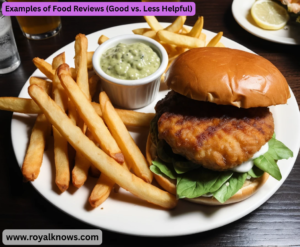
- “Rating: 3/5. We had high hopes but left disappointed.
- What we ordered: The ‘Signature Burger’ ($18) and the fish and chips ($22).
- The food: The burger was ordered medium but came out well-done and dry. The truffle fries were cold and soggy. The fish and chips were better—the beer batter was light and crispy and the fish flaky, but the mushy peas were bland.
- Service & Atmosphere: The server was pleasant but we had to wait 40 minutes for our food on a not-very-busy Tuesday night. The interior is modern and clean but the music was overwhelmingly loud.
- Verdict: For the price, we expected much better execution. Might give it another try in a few months to see if they’ve worked out the kinks.”
Key Elements to Evaluate in a Restaurant
When you’re writing or reading a review, these are the common categories people discuss:
- Food Quality: Taste, freshness, temperature, presentation, creativity.
- Service: Friendliness, efficiency, knowledge of the menu, timing.
- Ambiance: Noise level, cleanliness, decor, comfort, music.
- Value: Portion size relative to price, quality of ingredients.
- Menu Variety: Options for different diets (vegetarian, gluten-free, etc.).
- Location & Accessibility: Parking, public transport, wheelchair access.
Where to Find and Post Food Reviews
- Google Maps: The most universal and widely used. Great for overall scores and quick looks.
- Yelp: One of the original review sites, with a strong community. Can be very detailed.
- TripAdvisor: Essential for travel destinations and tourist areas.
- The Infatuation / Time Out: These are professional review sites that offer curated guides and lists (e.g., “Best Brunch in Chicago”).
- Instagram & TikTok: Perfect for visual reviews, quick hits, and discovering trending spots through food influencers. Look for hashtags like FoodReview, [City]Food (e.g., NYCFood),Foodie.
- Specialized Blogs: Many food bloggers provide incredibly detailed reviews with high-quality photography.
The Evolution of Food Reviews: From Print to TikTok
Food criticism has dramatically changed over the years:
- The Age of Print Critics: Once dominated by newspaper critics (like the famed New York Times critic, whose identity was kept secret for unbiased reviews). These were lengthy, authoritative pieces that could make or break a restaurant.
- The Rise of the “Foodie” & Blogs: Platforms like Blogger and WordPress democratized food criticism. Anyone could start a blog, leading to a surge in personal, passionate, and diverse voices.
- The Yelp & Google Era: Crowd-sourced reviews became king. The aggregate score became more influential than any single professional review.
- The Visual Age (Instagram): Food became as much about aesthetics as taste. A dish’s “Instagrammability” became a real factor in a restaurant’s success.
- The Video & Authenticity Age (TikTok/Reels): Short-form video reviews prioritize authenticity, humor, and immediacy over polished writing. “Get ready with me to try the viral pasta” or a quick, unedited “bite shot” with a reaction holds immense power.
Advanced Tips for Writing Next-Level Reviews
Move beyond the basics to provide truly exceptional insight.
- Context is Key: Mention why you were there. This helps readers frame your experience.
- Describe the “Signature” Element: What makes this place unique? Is it the wood-fired oven, the house-made charcuterie, the foraged ingredients, the chef’s specific regional focus?
- Comment on the Beverage Program: Don’t just review the food. How was the wine list? Cocktails? Were there local craft beers? A good sommelier or bartender is a huge plus.
- Note the Pace of the Meal: Was it rushed? Were there long waits between courses? A well-timed meal is a hallmark of great service and kitchen coordination.
- Be a Sherlock Holmes: Try to deduce why something was off. Was the restaurant visibly understaffed? Was the menu too large for the kitchen to execute well? This shows deeper understanding.
The Ethics and Etiquette of Reviewing
- Anonymity vs. Identity: Most professional critics review anonymously to get the same experience as a regular customer. For everyday reviewers, it’s a personal choice, but being transparent can add credibility.
- Timing: If you have a major complaint, tell the management during your visit. This is fair and often leads to a better outcome for everyone.
- Fact-Check: Get your facts straight. Was it the server’s fault, or was the kitchen just slammed? Is the dish actually “overpriced,” or are you unaware of the cost of high-quality (e.g., wild-caught, organic) ingredients?
- Avoid Personal Attacks: Critique the food and service, not the person. “Our server was inattentive” is fine. “Our server was an idiot” is not.
How to Be a “Super-Reader” of Reviews
Become a master at decoding what reviews really mean.
- The “Viral Dish” Trap: A place might have one incredible, photogenic dish that floods social media, but the rest of the menu might be mediocre. Look for reviews that mention multiple dishes.
Identify “Taste Mismatches”:
- A reviewer who loves classic steakhouses might pann a modern vegan tasting menu. That’s not a useful review for someone seeking a vegan tasting menu.
- Someone who dislikes “fancy” food might criticize a fine-dining restaurant for small portions and formal service.
- The “Soft Open” Glow: Beware of glowing reviews from the first week a restaurant is open. Staff is often hyper-attentive, and the kitchen is still finding its rhythm. The experience can change significantly after a month.
- Look for Reviews from “Local Guides” or “Elite Yelpers”: These users often have a history of detailed reviews, making their opinions more reliable than a one-time poster.
 xentro6@gmail.com