


Creating and documenting unique and rare dishes Of course. Creating and documenting unique and rare dishes is a fascinating intersection of culinary art, science, history, and storytelling. It’s about pushing boundaries while respecting ingredients and traditions. Here is a comprehensive guide to the process, from conception to documentation.
The Philosophy of “Unique” and “Rare”
- Unique: This doesn’t always mean “weird.” It can be a novel technique applied to a classic, an unexpected combination that works, or a personal story told through food. It’s about having a distinct point of view.
Rare: This often involves:
- Heirloom/Forgotten Ingredients: Using varieties of plants or animal breeds that have fallen out of commercial favor (e.g., Jerusalem artichokes, sunchoke, certain offal cuts, ancient grains like einkorn).
- Hard-to-Source Ingredients: Items that are seasonal, hyper-local, foraged, or require special cultivation (e.g., fiddlehead ferns, wild morel mushrooms, certain types of wild game).
- Ancient or Obscure Techniques: Reviving old preservation or cooking methods (e.g., fermenting in clay pots, cooking in salt crusts, preparing dishes from historical cookbooks).
- Cultural Rarities: Dishes from isolated communities or ones that are rarely made outside of specific ceremonies.
The Creative Process: From Spark to Plate
Inspiration: Where to Find Ideas
- Historical Cookbooks: Books like Apicius’s De Re Coquinaria (Ancient Roman), Hannah Glasse’s The Art of Cookery (1747), or Auguste Escoffier’s Le Guide Culinaire offer a window into forgotten flavors.
- Ethnography & Travel: Reading about or experiencing food cultures in remote areas. Documenting family recipes from elders can uncover rare gems.
- Nature & Foraging: Walking through forests, fields, or even urban landscapes can reveal edible ingredients most people overlook (e.g., pine needles, acorns, certain flowers). CRUCIAL: Only forage with an expert or using a trusted guide. Misidentification can be fatal.
- Scientific Techniques: Modernist cuisine (molecular gastronomy) can create unique textures and forms, like spherification, gels, or foams, using ingredients like sodium alginate or xanthan gum.
- Flavor Pairing Theory: Using scientific resources (like the FoodPairing® database or the book The Flavor Matrix) to discover unlikely but scientifically sound combinations (e.g., chocolate and blue cheese, strawberry and basil).
Sourcing & Experimentation
- Build a Network: Connect with local farmers, butchers, cheesemongers, and specialty purveyors. Tell them you’re looking for the unusual. Visit ethnic markets.
- The Kitchen Lab: Treat your kitchen like a laboratory.
- Keep a Notebook: Document every attempt. What did you do? What were the exact measurements? What worked? What failed spectacularly?
- Test in Small Batches: Don’t waste rare ingredients on a full recipe until you’re confident.
- The “Rule of One”: When creating a complex dish, introduce only one truly unique element at a time. Let it be the star, and use more familiar components to support it.
Technique & Execution
- Master the Basics: You must understand fundamental techniques (sautéing, braising, baking, emulsifying) before you can effectively break or elevate them.
- Balance is Key: No matter how rare an ingredient is, the dish must be balanced. Consider the five tastes: Sweet, Salty, Sour, Bitter, Umami. A unique dish should still be delicious.
- Texture: Rare ingredients often have unique textures. Highlight them or transform them. Contrast is important (e.g., creamy with crunchy, smooth with granular).
Documentation: Preserving Your Creation
- This is what separates a fleeting idea from a contribution to culinary knowledge. Your documentation should allow someone else to understand and potentially recreate your dish.
Essential Elements of Documentation:
The Meta-Data:
- Dish Name: Give it a descriptive or evocative title.
- Creator & Date: Who created it and when.
- Inspiration Source: What inspired this dish? (e.g., “Inspired by a 19th-century Scottish recipe for nettle pudding”).
- Concept & Story: A short paragraph explaining the idea behind the dish. What story are you telling? What experience are you trying to create?
The Recipe (The Blueprint):
Ingredients List:
- Be precise. Use weight (grams) for accuracy, especially in baking and modernist cuisine.
- Note specific brands if necessary (e.g., a specific type of artisanal soy sauce).
- For rare ingredients, include the Latin name (e.g., Allium tricoccum for ramps) and a brief description of their flavor profile.
Specify where you sourced it.
- Equipment List: Note any special equipment needed (e.g., immersion circulator, dehydrator, chamber sealer).
Methodology:
- Write clear, step-by-step instructions.
- Include doneness cues (“cook until the sauce coats the back of a spoon”) not just timers (“cook for 5 minutes”).
- Document resting times, temperatures, and specific techniques.
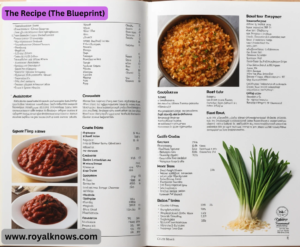
Visual Documentation:
- High-Quality Photography: Take well-lit, sharp photos from multiple angles: the finished dish, key steps in the process, and the unique ingredients themselves.
- Plating Diagram: A simple sketch showing how components are arranged on the plate. This is standard in professional kitchens.
Sensory Analysis:
This is the most critical part for a “unique” dish. Describe the experience in detail:
- Taste: What are the dominant flavors? How do they evolve?
- Aroma: What does it smell like?
- Texture/Mouthfeel: Is it creamy, crunchy, gelatinous, airy?
- Appearance: How does it look? Color, shape, gloss.
- Sound: Does it have an audible element (e.g., a crackling crust)?
Iteration Notes:
- Include notes from your testing process. What were previous versions like? What changes did you make and why? This shows the evolution of the dish.
Example: Documenting a Unique Dish
- Dish Name: “Ember-Roasted Sunchoke & Hay Infused Custard with Birch Syrup and Foraged Wood Sorrel”
- Creator: Chef [Your Name]
- Date: October 26, 2023
- Inspiration: Exploring pre-potato tuber cookery in European cuisine and using foraging to connect with the local landscape.
- Concept: A dish that tastes of the forest and autumn. The smokiness from the ember-roasting and hay connects to hearth cooking, while the sharp, citrusy wood sorrel cuts through the earthy, sweet richness of the sunchoke and birch.
Ingredients:
- 400g Sunchokes (Helianthus tuberosus), scrubbed
- 200g heavy cream
- 100g whole milk
- A large handful of clean, chemical-free wheat straw (hay)
- 3 large egg yolks
- 20g birch syrup (sourced from [Local Producer])
- A small handful of fresh wood sorrel (Oxalis acetosella), foraged from [General Location, e.g., “a shaded beech wood”]
Advanced Challenges & Ethical Considerations
- Creating and documenting unique and rare dishes Creating with rare and unique ingredients isn’t without its pitfalls. A responsible creator must navigate these waters carefully.
The Ethics of Sourcing:
- Sustainability: Is the ingredient endangered? Never use a species that is at risk (e.g., certain wild slow-growing mushrooms, shark fin, bluefin tuna). Prioritize invasive species (e.g., lionfish, wild boar in some regions, garlic mustard) as a sustainable choice for “rare” dining.
- Foraging Responsibility: Never over-harvest. Follow the “rule of thirds”: take only one-third of what you find, leave one-third for wildlife, and one-third to regenerate. Know the land and get permission.
- Cultural Respect: When drawing inspiration from a specific culture, especially an indigenous or marginalized one, do so with respect. Avoid appropriation. Acknowledge the source, understand the context of the dish, and don’t trivialize sacred or ceremonial foods. It’s the difference between “inspired by” and “copying.”
The Safety Factor:
- Misidentification: This is the greatest danger in foraging. Never eat anything you cannot identify with 100% certainty. Use multiple field guides and consult experts. Many deadly mushrooms look like edible ones.
- Novel Techniques: Fermentation, curing, and aging require precise control of temperature, salinity, and pH to prevent the growth of harmful pathogens like C. botulinum. Don’t wing it; use scientifically tested guidelines.
- Allergens: Unique ingredients may introduce novel allergens. Be transparent about every component in your dish.
The “Deliciousness” Mandate:
- The most common failure of “unique” food is prioritizing novelty over taste. Constantly ask yourself: “Is this actually good, or is it just interesting?” If it’s only interesting, go back to the drawing board.
Case Studies of Unique & Rare Creations
Let’s apply the framework to three hypothetical dishes.
- Case Study 1: Reviving a Historical Recipe
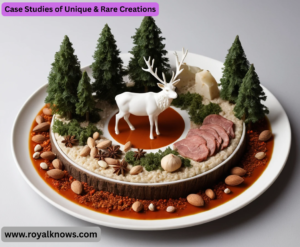
- Dish: Sotelty of Stag (Inspired by a Medieval English recipe)
- Concept: A edible sculpture (“sotelty”) served at feasts to showcase wealth and skill. This version is a modern interpretation focused on flavor, not just spectacle.
Unique/Rare Elements:
- Historical Technique: Using a puree of almonds and milk to create a creamy base instead of modern dairy-heavy techniques.
- Spice Profile: Using historically accurate spices like grains of paradise, long pepper, and sandalwood instead of black pepper.
- Presentation: Forming a paste of the stag meat and spices into a miniature, edible “forest” scene.
Documentation Focus:
- Story: Explain the history of sotelties and their role in medieval banquets.
- Ingredient Footnotes: Describe what grains of paradise taste like (citrusy, peppery) and where to source them.
- Challenge Note: “Modern palates may find the lack of salt surprising (salt was expensive). I’ve added a small amount for balance but kept it lower than a modern stew.”
Case Study 2: Modernist Foraging
- Creating and documenting unique and rare dishes Dish: “Forest Floor” (A modernist take on foraging)
- Concept: To capture the complete sensory experience of walking through an autumn forest in a single, elegant dish.
Unique/Rare Elements:
- Foraged Ingredients: Wood sorrel, toasted acorns (processed into flour), lichen (treated to be edible).
- Modernist Technique: Mushroom soil sponge (made from dehydrated mushroom stock and agar for an earthy, airy texture), green apple gel, birch sap fluid gel.
- Sensory Element: The dish is presented on a plate chilled with liquid nitrogen to release a cool, misty “forest floor” aroma when served.
Documentation Focus:
- Sensory Analysis: Extremely detailed. “The cold aroma evokes damp earth. The sponge dissolves with an intense umami hit, the gel provides bright acidity, and the acorn crumble offers a nutty crunch.”
- Safety Warning: “CRITICAL: The lichen (Xanthoria parietina) must be boiled in multiple changes of water to remove bitter and harmful compounds. Do not skip this step.”
- Plating Sketch: A diagram is essential for this complex assembly.
Case Study 3: Rare Animal Product
- Dish: Grilled Criadillas with Salsa Verde
- Concept: To demystify and celebrate a rarely used offal cut by applying simple, powerful cooking techniques.
Unique/Rare Elements:
- Ingredient: Criadillas (Lamb testicles). They are extremely seasonal (only available during specific times of the year from lambing) and often discarded.
 xentro6@gmail.com