


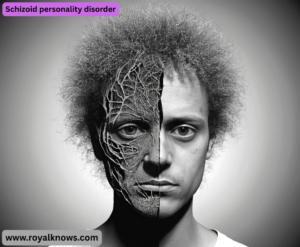
Schizoid personality disorder Schizoid Personality Disorder is a chronic and pervasive mental health condition characterized by a long-standing pattern of detachment from social relationships. a restricted range of emotional expression in interpersonal settings. People with SZPD are often described as “loners.” They genuinely prefer being alone and do not have a strong desire for close relationships, including with family. This is not due to anxiety or paranoia (as in other disorders) but rather a fundamental lack of interest.
Key Symptoms and Diagnostic Criteria (DSM-5)
- According to the Diagnostic and Statistical Manual of Mental Disorders, Fifth Edition (DSM-5), a diagnosis requires a pervasive pattern of detachment from social relationships and a restricted range of emotional expression, beginning by early adulthood and present in a variety of contexts, as indicated by four (or more) of the following:
- Almost always chooses solitary activities.
- Has little, if any, interest in having sexual experiences with another person.
- Takes pleasure in few, if any, activities.
- Lacks close friends or confidants other than first-degree relatives.
- Appears indifferent to the praise or criticism of others.
- Shows emotional coldness, detachment, or flattened affect (doesn’t show emotional reactions).
Common Characteristics and Behaviors
- Social Isolation: They do not seek out connections and often appear aloof or “in their own world.”
- Limited Emotional Expression: Their facial expressions and tone of voice may be flat and unresponsive. They may not react to situations that would typically elicit joy, anger, or sadness in others.
- Preference for Fantasy: Many with SZPD have a rich and complex internal fantasy world to which they retreat. They may be deeply engaged in intellectual, mechanical, or computer-based hobbies that they can do alone.
- Indifference: They often seem unmoved by what others think of them, whether it’s praise or rejection. This can be mistaken for arrogance, but it stems from a genuine lack of concern.
- Self-Identified as an “Outsider”: They typically see themselves as observers of life rather than participants.
Potential Causes
- The exact cause of SZPD is unknown, but it’s likely a combination of genetic, neurobiological, and environmental factors.
- Genetics: A predisposition for SZPD may be inherited. It is more common in people who have relatives with schizophrenia or schizotypal personality disorder.
- Brain Chemistry & Structure: There may be differences in brain pathways involving neurotransmitters like dopamine, which is linked to reward and motivation (including social motivation).
- Environment: Childhood experiences of emotional neglect, cold or unresponsive parenting, or trauma can contribute. A lack of warmth and attachment in early life may shape a child’s development toward emotional detachment as a coping mechanism.
Treatment and Management
- Treatment can be challenging because individuals with SZPD rarely seek help on their own, as they do not see their solitude as a problem. They are often pushed into therapy by a frustrated family member or a co-occurring issue like depression.
- Psychotherapy (Talk Therapy): This is the primary treatment.
- Cognitive-Behavioral Therapy (CBT): Can help identify and change problematic thought patterns and may teach social skills, though the goal is often to improve functioning rather than to create a social butterfly.
- Supportive Therapy: Provides a safe, non-judgmental, and stable environment. The therapeutic relationship itself can be a model for a low-demand, trusting connection.
- Group Therapy: Is generally not recommended, as the intense social interaction can be overwhelming and counterproductive.
- Medication: There are no medications approved specifically for SZPD. However, medications may be prescribed for co-occurring conditions such as depression or anxiety (e.g., antidepressants).
- Schizoid personality disorder The goal of treatment is typically not to “cure” the personality but to help the individual function better, manage co-occurring symptoms, and find a life structure that works for them.

Important Considerations and Stigma
- It’s Not a Choice: SZPD is a deeply ingrained personality structure, not a simple preference for being alone. It causes significant impairment and distress, even if that distress is not about loneliness.
- They Are Not Dangerous: A common and harmful misconception is that people who are isolated are potential criminals or violent. There is no link between SZPD and violence.
- Internal World: While they appear cold on the outside, many people with SZPD report a rich and complex internal life. Their lack of expression does not necessarily mean a complete lack of feeling.
- Quality of Life: With or without treatment, many individuals with SZPD can find fulfilling lives in careers and hobbies that align with their preference for solitude, such as night security, research, writing, or working with data.
The Internal Experience: What It Might Feel Like
The external view of someone with SZPD is one of detachment and coldness. The internal reality is more complex and often misunderstood:
- Schizoid personality disorder Anesthesia of Emotion: It’s not necessarily that they feel intense emotions and suppress them; rather, the emotional experience itself is often muted or absent. A major life event might be registered intellectually (“This is a situation where most people feel sad”) without the corresponding emotional wave.
- Solitude as a Default, Not a Punishment: For many, being alone is not a state of loneliness but one of comfort and equilibrium. Social interaction is often experienced as draining, confusing, or “loud,” while solitude is where they feel most themselves and can recharge.
- The Observer Self: They often feel like they are watching life through a pane of glass. They are the audience, not a participant in the human drama. This can lead to a profound sense of being fundamentally different or an “alien” species.
- Intellectualization Over Emotion: They may have a highly developed intellectual life. Emotions are processed through a cognitive lens—analyzed, categorized, and understood, rather than felt. Their inner world may be rich with ideas, philosophical concepts, and complex fantasies, but devoid of interpersonal content.
- Ambivalence about Connection: The desire for connection is often absent or severely stunted. However, some individuals may experience a faint, abstract wish for connection but find the practical realities of maintaining a relationship far too burdensome, leading them to abandon the effort.
Subtypes of Schizoid Personality
Theodore Millon, a prominent personality theorist, proposed four subtypes of SZPD. It’s important to note these are not official DSM diagnoses but can be helpful for understanding the variations in presentation:
- Languid Schizoid: Characterized by profound lethargy and low energy. They appear to be “sleepwalking through life,” with little drive or initiative.
- Remote Schizoid: The classic “hermit.” They are distant, disconnected, and seem to exist in their own world, often appearing inaccessible and odd.
- Depersonalized Schizoid: Experiences feelings of unreality about themselves or their body (depersonalization) or the external world (derealization). Their inner void is a central feature.
- Affectless Schizoid: Not just restricted emotionally, but specifically deficient in the capacity for passion, sentiment, or affection. They are consistently stoic and unmoved.
Controversies and Challenges in Diagnosis
- The “Disorder” Debate: A central controversy is whether SZPD is a true disorder or a stable personality style. If an individual is content with a solitary life, is not distressed by it, and functions adequately in a self-chosen niche, does it qualify as a mental illness? The diagnosis is typically only given when it causes significant functional impairment or subjective distress.
- Overlap with Autism: The line between SZPD and Autism Spectrum Disorder (ASD), particularly what was once called Asperger’s, is blurry. Both can involve social detachment and restricted affect. Key differentiators are that ASD involves core difficulties with social communication (e.g., understanding non-verbal cues) and the presence of restricted, repetitive patterns of behavior, interests, or activities (e.g., stimming, intense special interests, insistence on sameness), which are not defining features of SZPD.
- Schizoid personality disorder Masking and Camouflage: Some individuals with SZPD can learn to “mask” or mimic social behavior intellectually. They can perform social scripts at work or in brief interactions, but this is a conscious, draining performance, not an authentic expression of desire for connection. When they go home, they need to decompress for hours alone to recover.
Co-morbidities and Differential Diagnosis
It’s rare for SZPD to present in a “pure” form. It often co-occurs with:
- Major Depressive Disorder: Anhedonia (the inability to feel pleasure) is a core feature of both depression and SZPD. However, in depression, this is a change from a previous state and is often accompanied by deep sadness or guilt. In SZPD, it is a lifelong, stable trait.
- Anxiety Disorders: Social anxiety can occur, but it’s usually related to the draining nature of interaction rather than a fear of being judged.
- Other Personality Disorders: Especially Schizotypal (eccentricity and cognitive distortions) and Avoidant (desire for relationships but fear of rejection).
Living with and Managing SZPD
- For someone with SZPD, success is not measured by becoming gregarious, but by building a life that accommodates their needs while minimizing distress.
- Finding a “Niche” Career: Jobs with limited social demands are ideal. Night security, data analysis, archival work, programming, writing, lab research, or forestry can be excellent fits.
- Structured, Low-Demand Relationships: They may maintain a small number of relationships that have clear boundaries and low emotional demands. Online friendships can be preferable as they offer more control over the pace and depth of interaction.
The Role of Therapy (Revisited): Beyond general therapy, a clinician might focus on:
- Addressing Anhedonia: Using behavioral activation to help the person identify and engage in solitary activities that might provide a sense of satisfaction or meaning.
- Social Skills Training (if desired): Not to create friendships, but to navigate necessary interactions (e.g., with a boss or cashier) with less stress.
- Managing Co-morbid Depression: This is often the primary reason someone with SZPD stays in treatment.
 xentro6@gmail.com