


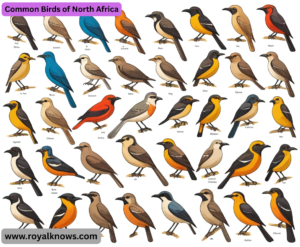
Common Birds of North Africa Of course. Here is a detailed overview of common birds found across North Africa, spanning from the Atlantic coast of Morocco to the Red Sea coast of Egypt. North Africa’s birdlife is a fascinating mix of Palearctic (European and Asian) species, Afrotropical (sub-Saharan) migrants and residents, and a number of birds unique to the region (endemics). The environment is dominated by the Sahara Desert, the Mediterranean coastline, and the Atlas Mountain range, each hosting very different species.
Key Habitats and the Birds Found There
- Mediterranean Coast & Wetlands: Crucial stopover for millions of migratory birds. Hosts gulls, terns, waders, and waterfowl.
- Atlas Mountains: A haven for raptors, forest species, and endemics. The higher elevations create “sky islands” for unique birds.
- Sahara Desert: Specialized species adapted to extreme heat and aridity.
- Oases & Palm Groves: Act as green lifelines in the desert, attracting a wide variety of passerines and doves.
Common and Notable Birds of North Africa
- Here are some of the most frequently encountered and iconic species, categorized for easier reference.
Birds of Prey (Raptors)
- Long-legged Buzzard
- Description: A large, sturdy buzzard common in rocky hills, semi-deserts, and mountains. Often seen perched on poles or rocks. Plumage is variable but often pale orange-brown.
Black-winged Kite
- Description: A beautiful, pale grey and white kite with black shoulder patches. Often seen hovering like a kestrel over open grasslands and farmland.
Lanner Falcon
- Description: A powerful and fast falcon of rocky outcrops and desert margins. It is a common resident and a skilled hunter of other birds.
Egyptian Vulture
- Description: A small, distinctive white vulture with a yellow, featherless face and a wedge-shaped tail. Sadly, it is endangered but can still be seen, especially in Morocco’s Atlas Mountains and coastal areas.
White-crowned Wheatear
- Description: A striking black-and-white wheatear of the Sahara. Entirely black except for a white rump and a clean white crown. It is a true desert specialist.
Desert Wheatear
- Description: Common in arid, stony areas. The male is pale sandy-brown with black wings and a black face mask.
Fulvous Babbler
- Description: A noisy, social sandy-brown bird with a long tail, often found in groups scurrying through scrubby vegetation and palm groves.
Tristram’s Warbler
- Description: A tiny, charming grey warbler with a chestnut wing patch, endemic to the Maghreb region (Morocco, Algeria, Tunisia). Found in scrubland on Atlas Mountain slopes.
House Bunting
- Description: Once considered a form of the Striated Bunting, it is now a full species common in villages, towns, and rocky areas. Males have a cheerful, scratchy song.
Desert Sparrow
- Description: A beautiful, pale sparrow of the Sahara, often found near oases and human settlements. Males are grey with a striking black eye stripe and chestnut wing patches.

Doves & Sandgrouse
Laughing Dove
- Description: A small, pinkish-brown dove with a speckled neck patch. Ubiquitous in gardens, cities, and farmlands across the region.
Crowned Sandgrouse
- Description: A master of desert adaptation. These plump, pigeon-like birds have cryptic plumage and fly long distances to waterholes at dawn and dusk.
Waterbirds & Waders
Greater Flamingo
- Description: A iconic sight in coastal lagoons and salt pans (e.g., in Tunisia, Algeria, and Morocco).
Slender-billed Gull
- Description: A common gull of coastal areas and inland lakes. As the name suggests, it has a long, slender, blood-red bill.
Audouin’s Gull
- Description: A smart, pale grey gull with a deep red bill and a white eye-ring. A Mediterranean specialty and a conservation success story, though still scarce.
Pied Avocet
- Description: An elegant black-and-white wader with a distinctive upturned bill, used for sifting through shallow water. Common in saline wetlands.
Other Notable Species
Hoopoe
- Description: Unmistakable with its orange plumage, black-and-white wings, and long, fan-like crest. Found in open country, orchards, and gardens. Its “hoo-hoo-hoo” call is a classic sound of the region.
African Blue Tit
- Description: In North Africa, the blue tits are a distinct species from their European cousins. They are more vividly blue and yellow and are common in woodlands, forests, and gardens.
Levaillant’s Woodpecker
- Description: The only woodpecker found in the Atlas Mountains of Morocco and Algeria. It is a green woodpecker with a red crown, very similar to the European Green Woodpecker but now classified as a separate species.
Endemic and Near-Endemic Species
- Birdwatchers seek these out as they are found primarily in North Africa:
- Moussier’s Redstart: A stunning black, white, and orange redstart of the Atlas Mountains.
- Algerian Nuthatch: Critically endangered and found only in a few tiny patches of forest in northeastern Algeria.
- Atlas Horned Lark: A distinctive subspecies (or potential future species) with a striking black-and-white face pattern, found on high Atlas plateaus.
- Maghreb Magpie: Recently split from the Eurasian Magpie, this species is found in Morocco, Algeria, and Tunisia. It has a patch of blue skin behind the eye and a smaller white shoulder patch.
Expanded Group Focus: Raptors of the Desert and Sky
North Africa’s open landscapes make it an excellent place for observing birds of prey.
Barbary Falcon
- Status: Often considered a subspecies of the Peregrine Falcon, but distinct in plumage and habitat.
- Description: Smaller and paler than the classic Peregrine, with a thin “moustache” stripe and a rufous wash on the nape. It is a resident of mountainous and rocky desert regions, expertly hunting birds like doves and swifts.
Short-toed Snake Eagle
- Status: A summer migrant and passage migrant. A master of hovering flight.
- Description: Often seen hanging in the wind over open scrubland, using its incredible vision to spot snakes and lizards, which make up the bulk of its diet. Identified by its pale underside and broad, rounded wings.
Booted Eagle
- Status: A common migrant and winter visitor.
- Description: A small, agile eagle that occurs in both a pale and a dark morph. The pale morph has striking white underwings with black tips. They are often seen soaring over wooded hills and forests.
The Challenge of Identification: Warblers and Shrikes
- Two groups that are abundant but can be tricky to identify are the warblers and shrikes, especially during migration periods.
Common Warblers:
- Subalpine Warbler (Curruca iberiae / C. inornata): Males are sleek grey with a rusty red throat and a white “moustache.” Very common in scrubby habitats during migration.
- Western Orphean Warbler (Curruca hortensis): A larger warbler with a stout bill, found in open woodlands. The male has a dark hood and a pale eye.
- Olivaceous Warbler (Iduna opaca): A common pale brown warbler of palm groves and oases, often heard before it’s seen. It has a long bill and a habit of flicking its tail.

Common Shrikes:
- Common Birds of North Africa Southern Grey Shrike (Lanius meridionalis): A large, pale shrike of open country. Often seen perched prominently on wires and bushes, watching for large insects, lizards, and small birds to impale on thorns (a behavior called “lardering”).
- Woodchat Shrike (Lanius senator): A stunning summer visitor. The male has a chestnut crown, black and white wings, and a black face mask. Prefers orchards and open woodlands.
- Lesser Grey Shrike (Lanius minor): A passage migrant. Similar to the Great Grey but smaller, with a broader black face mask and a shorter, stouter bill.
North African Birding Hotspots
To see the full diversity, certain locations are unparalleled:
- Merja Zerga (Morocco): A massive lagoon on the Atlantic coast. Arguably the most important wetland in North Africa for waders (shorebirds), ducks, and gulls. It hosts tens of thousands of wintering birds like Eurasian Oystercatchers, Bar-tailed Godwits, Dunlins, and Greater Flamingos. Rarities from the Arctic and Northern Europe appear here regularly.
- The Atlas Mountains (Morocco & Algeria): The High Atlas and Middle Atlas are the stronghold for regional endemics.
- Oukaimeden Valley (High Atlas, Morocco): The best place to see the Atlas Horned Lark and Alpine Chough. Shore Larks and Rock Sparrows are also common.
- Cedre Forest (Middle Atlas, Morocco): Home to the Great Spotted Woodpecker (North African subspecies numidus), African Blue Tit, Moussier’s Redstart, and Levaillant’s Woodpecker.
- Souss-Massa National Park (Morocco): A coastal park protecting a river estuary and sandy beaches. It’s the best place to see the critically endangered Northern Bald Ibis (outside of a reintroduction program in Austria). It also hosts Eleonora’s Falcon (a summer breeder that times its breeding with the autumn migration to feed its young on passing songbirds) and many other coastal species.
- Oases of the Sahara (e.g., Siwa in Egypt, Tozeur in Tunisia): These life-giving pockets host a completely different set of birds. Look for Desert Sparrow, Fulvous Babbler, Brown-necked Raven, White-crowned Wheatear, and Laughing Dove. Migrants are funneled here, making an oasis a surprising place to find exhausted European songbirds like Willow Warblers or Common Redstarts.
- Gebel Elba (Egypt): This mountainous region near the Sudanese border is a unique biome, catching just enough moisture to create a “mist oasis.” It hosts Afrotropical species found nowhere else in Egypt, like Rosy-patched Bushshrike, Golden-winged Grosbeak, and Dunn’s Lark.
 xentro6@gmail.com