

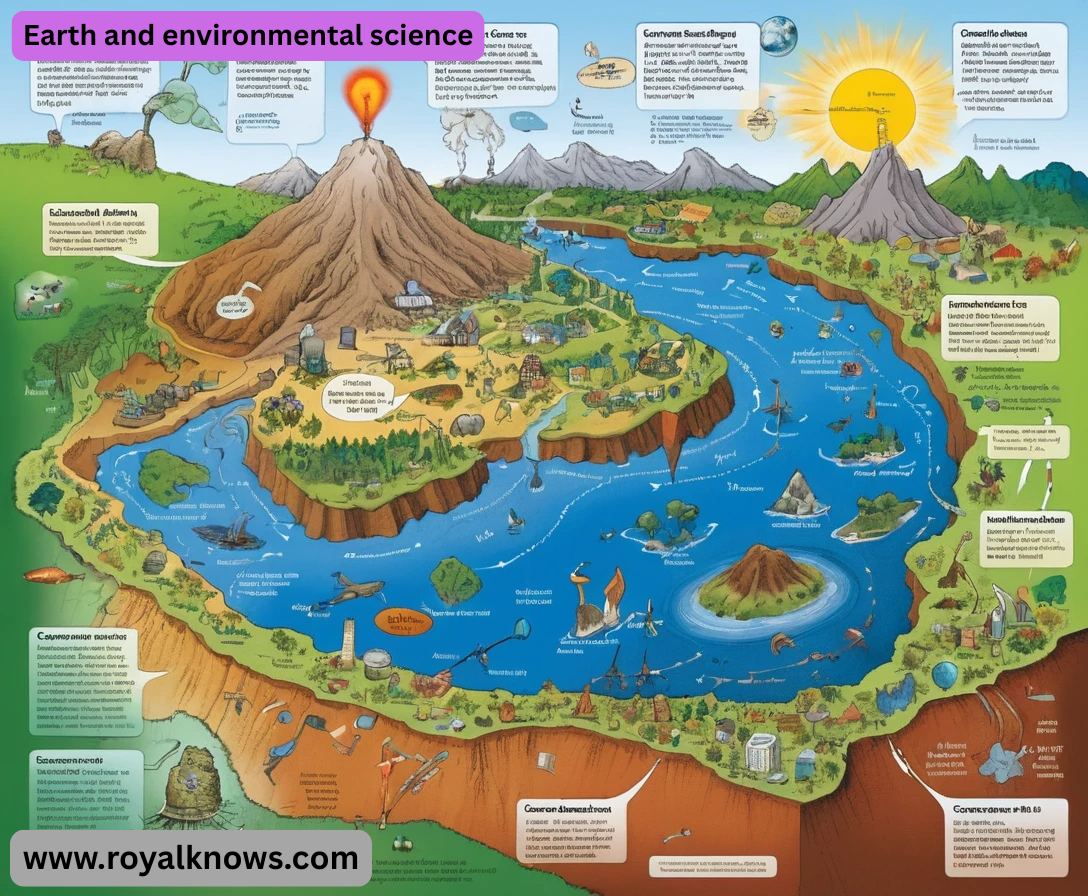
Earth and environmental science Of course. Earth and Environmental Science is a vast and critically important field that integrates the study of the Earth’s physical systems with the ways humans interact with and impact those systems. Here’s a comprehensive breakdown of what it encompasses, why it matters, and key topics within it.

What is Earth and Environmental Science?
It’s an interdisciplinary field that combines:
- Earth Science (Geoscience): The study of the Earth’s physical structure, composition, and processes. This includes geology, oceanography, meteorology, and astronomy (as it relates to Earth).
- Environmental Science: The study of the environment and the solutions to environmental problems. It integrates physical and biological sciences (e.g., ecology, chemistry, biology) with social sciences (e.g., geography, economics, policy) to understand human impacts and develop sustainable solutions.
- In essence, Earth Science asks, “How does our planet work?” while Environmental Science asks, “How do we live sustainably on it?”
Why is it Important?
This field is fundamental to addressing the most pressing challenges of our time:
- Climate Change: Understanding the causes, effects, and mitigation strategies for a warming planet.
- Resource Management: Responsibly managing finite resources like freshwater, minerals, and fossil fuels.
- Natural Hazards: Predicting and preparing for earthquakes, volcanoes, hurricanes, and floods to save lives and property.
- Pollution: Identifying sources and cleaning up contamination in our air, water, and soil.
- Biodiversity Loss: Protecting ecosystems and species from extinction due to human activities.
- Sustainability: Informing policy and personal choices to create a society that can thrive without degrading its natural systems.
Major Global Challenges in the Field
- Climate Change: Driven by the enhanced greenhouse effect from burning fossil fuels, leading to global warming, sea-level rise, ocean acidification, and more extreme weather events.
- Biodiversity Loss: The current extinction rate is hundreds of times higher than the natural background rate, primarily due to habitat destruction, pollution, and climate change.
- Water Scarcity: Many regions face severe water shortages due to overuse, pollution, and climate change, posing risks to agriculture and human health.
- Pollution: Plastic pollution in the oceans, air pollution in megacities, and “forever chemicals” (PFAS) in drinking water are pervasive global issues.
- Land Degradation: Deforestation, desertification, and soil erosion are reducing the amount of productive land available for food production and healthy ecosystems.
What Do Earth and Environmental Scientists Do?
Professionals in this field have diverse careers:
- Geologist: Locate mineral and energy resources, assess geologic hazards.
- Hydrologist: Manage water resources, study water quality and availability.
- Meteorologist/Climatologist: Forecast weather, study climate patterns and change.
- Oceanographer: Study marine ecosystems, currents, and the seafloor.
- Environmental Consultant: Help companies comply with regulations, clean up contaminated sites.
- Conservation Scientist: Manage and protect natural resources in parks and forests.
- Policy Analyst: Develop and analyze environmental laws and regulations.
- Environmental Engineer: Design technologies to tackle pollution and waste management.
How Can You Get Involved?
- Educate Yourself: Follow reputable sources like NASA, NOAA, IPCC, and NSF.
- Make Sustainable Choices: Reduce energy consumption, minimize waste, choose sustainable products.
- Get Involved Locally: Participate in community clean-ups, support local conservation efforts, and advocate for green policies in your town.
- Consider a Career: If you’re passionate about solving these problems, it’s a field with growing importance and opportunity.
Deep Dive: Key Earth Science Concepts
Plate Tectonics: The Engine of the Planet
- This is the unifying theory that explains the geography and geology of Earth’s surface.
- What it is: The Earth’s lithosphere (crust and upper mantle) is broken into giant, moving plates.
- How it works: Convection currents in the semi-fluid asthenosphere below drag these plates around.
Boundary Types:
- Divergent: Plates pull apart (e.g., Mid-Atlantic Ridge), creating new crust and causing volcanic activity.
Convergent: Plates collide. This can cause:
- Subduction: One plate plunges under another, creating deep ocean trenches and violent volcanoes (e.g., Ring of Fire).
- Mountain Building: Two continental plates crumple upwards (e.g., Himalayas).
- Transform: Plates slide past each other horizontally, causing major earthquakes (e.g., San Andreas Fault).
The Rock Cycle: The Story of Every Stone
A continuous process that creates and transforms rocks through time.
- Igneous Rocks: Form from the cooling and solidification of magma or lava (e.g., granite, basalt).
- Sedimentary Rocks: Form from the compaction and cementation of weathered sediments (e.g., sandstone, limestone). They often contain fossils.
- Metamorphic Rocks: Form when existing rocks are changed by intense heat and pressure (e.g., marble, slate).
Earth’s Climate System: It’s All About Energy Balance
- The climate is determined by the balance between energy entering (from the sun) and energy leaving (radiated back to space) the Earth system.
- The Greenhouse Effect: A natural and essential process where certain gases (e.g., CO₂, CH₄, H₂O vapor) in the atmosphere trap heat, keeping the planet warm enough for life.
- Albedo: The reflectivity of a surface. Ice and snow have high albedo (reflect sunlight), while dark ocean water has low albedo (absorbs sunlight). This creates a powerful feedback loop.
Deep Dive: Critical Environmental Issues
Ocean Acidification: The “Other Carbon Problem”
- Cause: The ocean absorbs about 25-30% of the CO₂ we release. This reacts with seawater to form carbonic acid, lowering the ocean’s pH.
- Impact: A more acidic ocean makes it difficult for marine organisms like corals, oysters, and plankton to build their calcium carbonate shells and skeletons. This threatens the entire marine food web.
The Nitrogen Cycle & Dead Zones
- Cause: The Haber-Bosch process (creating synthetic fertilizer) and burning fossil fuels have massively altered the global nitrogen cycle. Excess fertilizer runs off from farms into rivers and then the ocean.
- Impact: This nutrient overload causes massive algal blooms. When the algae die and decompose, they consume all the oxygen in the water, creating “dead zones” (hypoxic areas) where most marine life cannot survive.
The Sixth Mass Extinction
- Context: Earth has witnessed five previous mass extinction events in its history.
- Cause: The current, ongoing extinction event is driven almost entirely by human activities: habitat destruction, overexploitation (hunting/fishing), pollution, and climate change.
- Scale: Species are going extinct at a rate 100 to 1,000 times higher than the natural background rate.
The Toolbox: How Earth and Environmental Scientists Work
This field relies on advanced technology and interdisciplinary methods.
- Remote Sensing: Using satellites and aircraft to collect data on large-scale phenomena like deforestation, sea surface temperatures, ice sheet melt, and urban growth.
- Geographic Information Systems (GIS): Powerful computer mapping software that layers spatial data (e.g., soil type, rainfall, population density, pollution sources) to analyze patterns and relationships.
- Paleoclimatology: Studying ancient climates through proxy records like:
- Ice Cores: Trapped air bubbles in ancient ice reveal past atmospheric composition and temperature.
- Tree Rings: Width of rings indicates years of good or poor growth (climate conditions).
- Sediment Cores: Layers of mud on lake/ocean floors contain pollen, fossils, and chemicals that record past environments.
- Isotope Geochemistry: Analyzing different isotopes of elements (e.g., oxygen, carbon) in rocks, ice, or fossils to determine past temperatures, source of pollutants, and the age of materials (radiometric dating).
- Climate Modeling: Using supercomputers to run complex mathematical simulations of the Earth’s climate system. These models are our primary tool for predicting future climate change under different greenhouse gas emission scenarios.
Philosophical & Ethical Dimensions
Environmental science often grapples with complex questions that go beyond pure data:
- Environmental Ethics: What is our moral obligation to future generations and other species? Do natural entities like rivers or ecosystems have intrinsic rights?
- Tragedy of the Commons: How do we manage shared resources (like the atmosphere or fisheries) to prevent individuals from exploiting them to the detriment of everyone?
- Precautionary Principle: The idea that if an action or policy has a suspected risk of causing harm to the public or the environment, the burden of proof that it is not harmful falls on those taking the action, even if some cause-and-effect relationships are not fully established scientifically.
- Environmental Justice: The fair treatment and meaningful involvement of all people regardless of race, color, national origin, or income with respect to the development and enforcement of environmental laws. It highlights that minority and low-income populations often bear a disproportionate share of environmental hazards.
 xentro6@gmail.com