
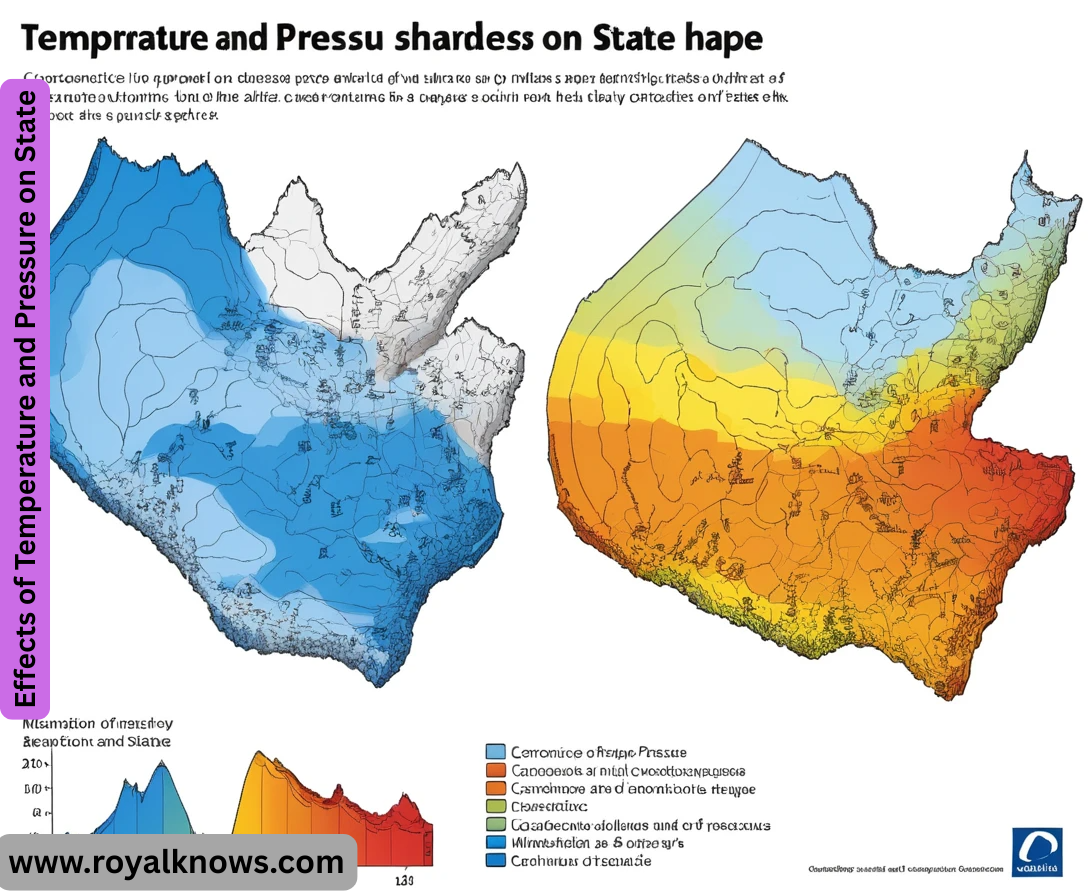
Effects of Temperature and Pressure on State Of course. The effects of temperature and pressure on the state of matter (solid, liquid, gas) are fundamental concepts in physics and chemistry. They are governed by the interplay between the kinetic energy of particles and the forces between them. Here’s a detailed breakdown of these effects.
The Core Principle: Kinetic Energy vs. Intermolecular Forces
- Temperature is a measure of the average kinetic energy of a substance’s particles. Higher temperature means particles are moving faster.
- Intermolecular Forces are the attractive forces between molecules. They act like “glue” holding particles together.
- Pressure is the force applied per unit area. It can physically squeeze particles closer together, effectively increasing the strength of their interactions.
The state of matter is a battle between these two factors:
- If kinetic energy wins, particles break free, leading to a less ordered state (melting, evaporating).
- If intermolecular forces win, particles stay locked together, leading to a more ordered state (condensing, freezing).
Effects of Temperature (at Constant Pressure)
Changing temperature directly changes the particles’ kinetic energy.
Increasing Temperature
- Solid to Liquid (Melting): Added energy makes particles vibrate more violently. Eventually, they overcome the rigid structure of the solid and begin to slide past one another.
- Liquid to Gas (Vaporization/Boiling): Added energy allows particles at the surface to move fast enough to completely overcome intermolecular forces and escape into the gas phase. With enough energy, this happens throughout the liquid (boiling).
- Solid to Gas (Sublimation): In some cases (e.g., dry ice, iodine), added energy allows particles to break directly from the solid structure into a gas without becoming a liquid first.
Decreasing Temperature (Removing Energy)
- Gas to Liquid (Condensation): As particles slow down, intermolecular forces can pull them together into a liquid.
- Liquid to Solid (Freezing): As particles slow down further, they settle into fixed, orderly positions, forming a solid.
- Gas to Solid (Deposition): Water vapor (gas) turning directly into frost (solid) on a cold window is a common example.
Effects of Pressure (at Constant Temperature)
Changing pressure affects the space between particles, influencing how strongly intermolecular forces can act.
Increasing Pressure
- Gas to Liquid (Condensation): Squeezing a gas forces molecules closer together. This increases the effect of intermolecular forces, making it easier for them to condense into a liquid. This is why high-pressure systems are associated with clearer skies (no condensation).
- Liquid to Solid (Freezing): For most substances, increasing pressure makes it harder for a solid to melt, so it favors the solid state. Applying pressure helps force the particles into a more ordered, dense structure. Water is a famous exception to this.
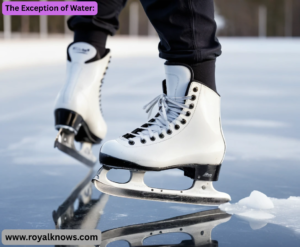
The Exception of Water:
- The solid form of water (ice) is less dense than its liquid form. This is why ice skates work: the immense pressure from the blade melts a thin layer of ice, creating a slippery surface for the skate to glide on. This is known as regelation.
Decreasing Pressure
- Liquid to Gas (Vaporization/Boiling): Reducing pressure makes it easier for particles to escape from a liquid into the gas phase. This is why water boils at a lower temperature at high altitudes (where atmospheric pressure is lower). For example, on Mount Everest, water boils at around 70°C (158°F) instead of 100°C (212°F).
- Solid to Liquid (Melting): For most substances, lowering pressure makes it slightly easier to melt.
Visualizing the Relationship: The Phase Diagram
- The combined effects of temperature and pressure are perfectly summarized in a phase diagram. This is a graph of pressure vs. temperature that shows the regions where each state is stable.
- The Lines (Curves): Each line represents the conditions where two phases exist in equilibrium (e.g., solid and liquid coexist on the melting point line).
- The Triple Point: The unique combination of temperature and pressure where all three phases (solid, liquid, and gas) coexist in equilibrium.
- The Critical Point: The temperature and pressure above which the distinction between liquid and gas disappears. The substance becomes a supercritical fluid, with properties of both a liquid and a gas.
How to read it:
- Pick a temperature and pressure.
- Find that point on the graph.
- The region it falls in (solid, liquid, gas) tells you the state of matter at those conditions.
- Example: To see why water boils at a lower temperature on a mountain:
- Follow the horizontal line for “Low Pressure” on the Y-axis.
- As you move right (increasing temperature), you will hit the liquid-gas boundary at a lower temperature than you would at the “Standard Pressure” line.
Advanced Concepts and Nuances
Beyond Solids, Liquids, and Gases: Plasma and Beyond
- While we often focus on three states, temperature can create a fourth fundamental state:
- Plasma: When a gas is heated to extremely high temperatures (thousands of degrees Celsius), the atoms themselves break apart. Electrons are stripped from their nuclei, creating a soup of positively charged ions and free electrons. Plasma is the most common state of matter in the universe (e.g., stars, lightning, neon signs). This is almost exclusively a temperature-driven phenomenon.
The Anomaly of Water Explained
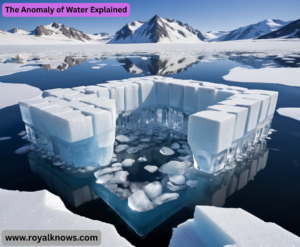
- Effects of Temperature and Pressure on State Water’s unique behavior (expanding upon freezing) is due to the hexagonal crystal structure of ice, which holds molecules further apart than in liquid water. This has profound consequences:
- Pressure-Induced Melting: As shown in the phase diagram below, increasing pressure on ice lowers its melting point. The pressure destabilizes the open solid structure, forcing it into the more efficient liquid packing.
- Why Ice Floats: This density anomaly is why ice floats on water. This is crucial for life, as it insulates lakes and oceans, allowing aquatic life to survive winters.
Supercritical Fluids: Blurring the Lines
- At the critical point (a specific high temperature and pressure on the phase diagram), the liquid and gas phases become indistinguishable.
- What it is: A supercritical fluid has the density of a liquid but the viscosity and diffusivity of a gas.
- Applications: This is not just a laboratory curiosity. It’s used in commercial processes like:
- Decaffeinating Coffee: Supercritical carbon dioxide is used to dissolve and remove caffeine from coffee beans without using harsh chemical solvents.
- Dry Cleaning: Replacing toxic chemicals like perchloroethylene with supercritical CO₂.
- Essential Oil Extraction: Gently extracting oils from plants.
Deeper Look at Phase Transitions
Evaporation vs. Boiling
- Both are liquid-to-gas transitions, but they are fundamentally different:
- Evaporation: A surface phenomenon that occurs at any temperature where particles with high enough kinetic energy escape the liquid’s surface.
- Boiling: A bulk phenomenon that occurs throughout the liquid when its vapor pressure equals the surrounding atmospheric pressure. This is why boiling point is so dependent on external pressure.
Sublimation and Deposition in Action
- These are not rare events; they are part of everyday life:
Sublimation (Solid → Gas):
- Dry Ice (Solid CO₂): Used for creating fog effects because it sublimes at -78.5°C at atmospheric pressure, never becoming a liquid.
- Freeze-Drying: Food is frozen, and then a vacuum (low pressure) is applied. The ice sublimates directly into vapor, preserving the food’s structure and flavor.
Deposition (Gas → Solid):
- Frost Formation: On cold mornings, water vapor in the air deposits directly as ice crystals on surfaces like grass and windows.
- Semiconductor Manufacturing: Chemical Vapor Deposition (CVD) uses this process to deposit thin films of material onto silicon wafers.
 xentro6@gmail.com