

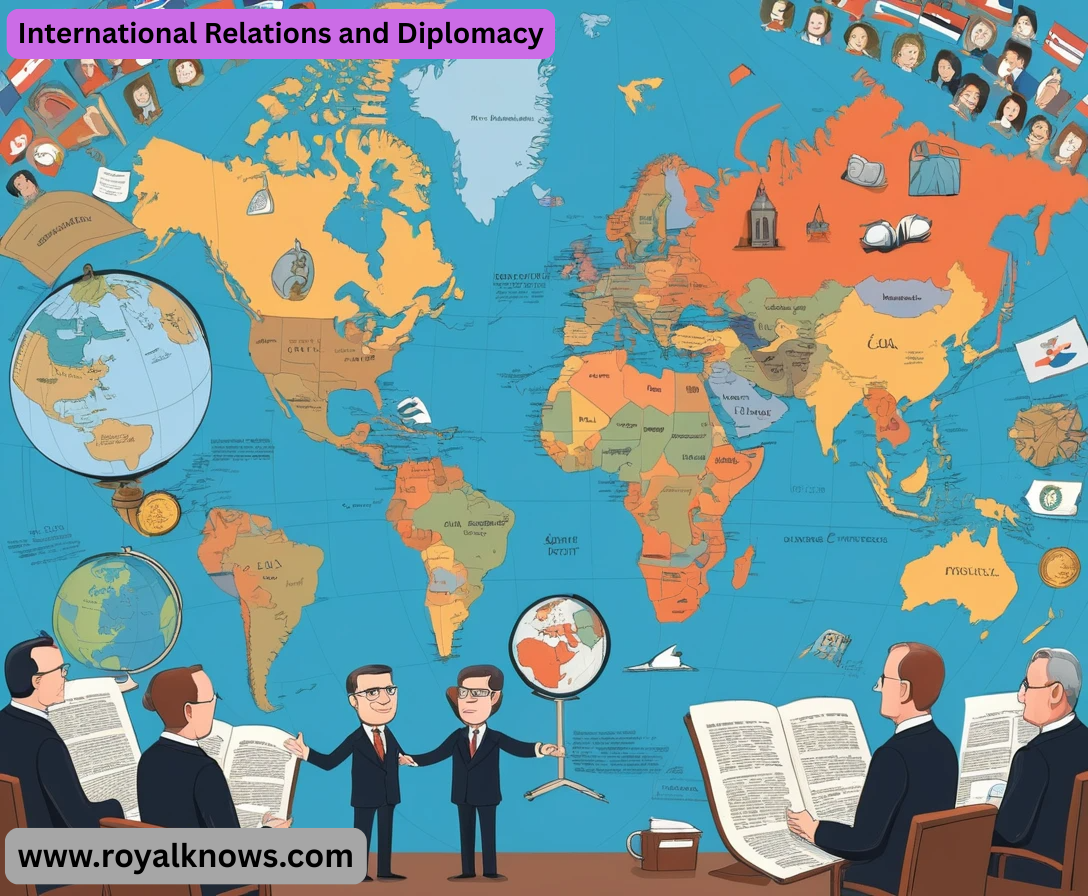
International Relations and Diplomacy Of course. Here is a comprehensive overview of International Relations (IR) and Diplomacy. including their definitions, key concepts, and how they interact in the modern world.
Core Definitions
- International Relations (IR): This is the academic field that studies interactions between countries and the broader international system. Think of it as the “science” or “theory” behind world events.
- Diplomacy: This is the practice and profession of managing international relations. It is the tool through which states conduct their foreign policy.
- In simple terms: IR is the study, while Diplomacy is the action.
Key Concepts in IR
- Sovereignty: The principle that a state has full authority and independence over its own territory and domestic affairs.
- This can be hard power (military force, economic sanctions) or soft power (cultural appeal, political values, diplomacy).
- National Interest: The goals and objectives a state seeks to achieve in international relations (e.g., security, economic prosperity, influence).
- Globalization: The process of interaction and integration among people, companies, and governments worldwide, accelerating the flow of goods, capital, and information.
The Practice of Diplomacy
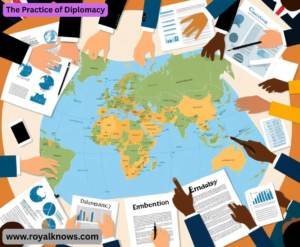
Diplomacy is the primary instrument of foreign policy. Its key functions include:
- International Relations and Diplomacy Representation: Acting on behalf of one’s country abroad (e.g., through an embassy).
- Negotiation: Bargaining with other actors to reach agreements (e.g., trade deals, climate accords, ceasefire treaties).
- Promotion of Values and Interests: Advocating for one’s country’s policies, culture, and business interests.
Key Diplomatic Tools:
- Bilateral and Multilateral Diplomacy: Negotiating between two states or many states (e.g., at the UN).
- Summits: Meetings between heads of state.
- Treaties and Agreements: Formal, binding documents between states.
- Public Diplomacy: Engaging directly with foreign publics to shape perceptions (e.g., cultural exchanges, media outreach).
- Economic Diplomacy: Using economic tools (aid, sanctions, trade policy) to achieve foreign policy goals.
- Track II Diplomacy: Unofficial, informal dialogue between non-governmental actors (academics, conflict resolution specialists) to resolve conflicts.
The Changing Landscape: New Actors and Challenges
- The field is no longer just about states talking to states. The 21st-century landscape is more complex:
Non-State Actors:
- Intergovernmental Organizations (IGOs): UN, NATO, European Union, African Union.
- Non-Governmental Organizations(NGOs): Amnesty International, Red Cross, Greenpeace.
- Multinational Corporations (MNCs): Apple, Shell, Toyota—whose economic power rivals many states.
- Transnational Threat Networks: Terrorist organizations like ISIS or Al-Qaeda.
- Global Challenges: Modern problems often cannot be solved by any single country, requiring complex diplomatic solutions.
Climate Change
- Global Pandemics (e.g., COVID-19)
- Cyber Warfare and Security
- International Terrorism
- Nuclear Proliferation
- Conclusion: The Symbiotic Relationship
- IR theory provides the frameworks for understanding the world, helping diplomats and policymakers formulate strategies. It asks: “What are the dynamics at play? What is likely to happen?”
- Diplomacy is the practical application of that understanding. It is the channel through which states navigate these dynamics to achieve their goals. It asks: “How do we engage with others to get what we want and avoid conflict?”
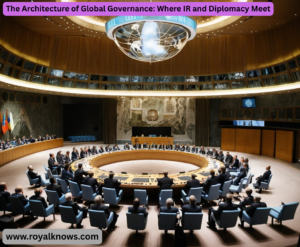
The Architecture of Global Governance: Where IR and Diplomacy Meet
- This is the ecosystem of rules, institutions, and norms that states create to manage their interactions. It’s the tangible outcome of both IR theory (the liberal idea that institutions foster cooperation) and diplomatic practice (the hard negotiation to create them).
- The United Nations System: The central pillar of post-WWII global governance.
- UN General Assembly (UNGA): The main deliberative body where all 193 member states have a voice (a “town hall of the world”).
- UN Security Council (UNSC): The powerhouse responsible for international peace and security. Its five permanent members (P5: U.S., Russia, China, France, UK) hold veto power, a stark reflection of Realist power politics within a liberal institution.
- Specialized Agencies: WHO (health), IMF (monetary stability), WTO (trade), UNESCO (education & culture). These are where technical and economic diplomacy happens daily.
- Regional Organizations: Often more effective than global ones due to shared cultures and closer interests.
- European Union (EU): The most advanced model of regional integration, with its own parliament, court, and currency (for some members).
- NATO (North Atlantic Treaty Organization): A military alliance based on collective defense (Article 5: an attack on one is an attack on all).
- African Union (AU), ASEAN (Association of Southeast Asian Nations), etc.: Promote economic integration, security, and political cooperation within their regions.
- International Law: The rules that bind states. While powerful states can sometimes ignore it, it provides a crucial framework for legitimacy and predictable relations.
Critical Issues and Debates in Modern IR
- The Democratic Peace Theory: A core liberal idea that democracies rarely, if ever, go to war with each other. This is a major driver of the foreign policy of many Western states, which promotes democracy abroad.
- Is China’s rise peaceful? Will it challenge the U.S.-led liberal international order? This situation is a classic case study for Power Transition Theory (what happens when a rising power challenges an established one).
- The End of Sovereignty? Globalization, the responsibility to protect (R2P) civilians from genocide, and international institutions are all chipping away at the traditional Westphalian concept of absolute state sovereignty. This creates tension between global norms and national interests.
- The “Inside-Out” Link: Domestic politics now profoundly shapes international relations. The rise of populism, nationalism, and isolationist movements (e.g., “America First”) in many countries directly constrains what diplomats can do and undermines multilateral cooperation.
- Ethics vs. Realpolitik: The constant tension between pursuing moral foreign policy goals (e.g., human rights) and pursuing hard-nosed national interests (e.g., securing oil, countering a rival). Should the U.S. support an authoritarian regime because it is a strategic ally against terrorism?
Careers in IR and Diplomacy
This field leads to diverse and impactful career paths:
- Foreign Service Officer: The classic “diplomat,” working for a country’s foreign ministry (e.g., the U.S. Department of State), serving in embassies abroad.
- International Civil Servant: Working for an IGO like the United Nations, World Bank, or European Union.
- Policy Analyst/Researcher: Working at think tanks (e.g., Carnegie Endowment, Chatham House), universities, or research institutes to analyze events and develop policy recommendations.
- NGO Professional: Working for organizations like Human Rights Watch, International Crisis Group, or Oxfam on advocacy, relief, and development.
- Journalism: Reporting on international affairs for major news outlets.
- Corporate Sector: Managing international risk, government relations, or global strategy for a multinational company.
- Military and Intelligence: Roles focused on geopolitical analysis and strategic planning.
 xentro6@gmail.com