

Communications and IT Of course. The fields of Communications and Information Technology (IT) are deeply intertwined and form the backbone of the modern digital world. Here’s a comprehensive breakdown of each field and how they connect.
The Core Concepts: Separate but Inseparable
Think of it this way:
- Communications is about the “what” and “why”—the content, meaning, and purpose of the message.
- Together, they enable the flow of information that powers businesses, governments, and social interactions.
Communications
A. Human Communications
- This is the study of how people create and share meaning. It’s foundational to marketing, public relations, management, and media.
Key Areas:
- Verbal Communication: Written and spoken words.
- Mass Communication: Reaching large audiences via television, radio, newspapers, and digital platforms.
- Corporate Communication: Internal comms (within a company) and external comms (public relations, branding, advertising).
- Interpersonal Communication: One-on-one or small group interactions.
B. Telecommunication
- This is the technical side of communication over a distance.
Key Technologies:
- Networks: The infrastructure (e.g., fiber optic cables, cell towers, satellites) that carries data.
- Protocols: The rules that govern data transmission (e.g., TCP/IP for the internet, SIP for voice over IP).
- Types: Wired (telephone lines, coaxial cable, fiber optics) and Wireless (Wi-Fi, Bluetooth, 4G/5G, satellite).
Information Technology (IT)
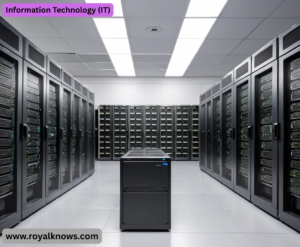
- IT involves the use of computers, networking, storage, and other physical devices, infrastructure, and processes to create, process, store, secure, and exchange all forms of electronic data.
Key Domains:
- Hardware: Physical components like servers, computers, routers, and data centers.
- Software: Applications and operating systems that run on hardware.
- Networking: Connecting computers and devices to share resources (a subset of telecommunications).
- Data Management & Storage: Databases (SQL, NoSQL), data warehouses, and cloud storage solutions.
- Technical Support & Administration: Maintaining systems and helping users.
Key Intersection Fields:
- Unified Communications (UC): A perfect example of the merger. UC integrates multiple real-time communication services (e.g., instant messaging, voice, video conferencing, desktop sharing) into a single, cohesive IT platform.
- Internet of Things (IoT): Everyday objects (IT) are embedded with sensors that communicate data over a network (Telecom) to provide insights (e.g., a smart thermostat communicating usage data to your phone).
- Cloud Computing: IT resources (servers, storage, software) are delivered over the internet (Telecom) as a service. The communication network is essential to accessing the IT power in the cloud.
- Digital Marketing: Using IT tools (analytics software, ad servers, email platforms) to execute communication strategies for branding and sales.
Career Paths
- The blend of skills from both fields is highly valuable.
Communications-Focused (with IT knowledge):
- Social Media Manager: Uses IT platforms (scheduling tools, analytics dashboards) to execute communication strategies.
- Content Marketing Specialist: Creates content optimized for digital channels (websites, SEO, email systems).
- Technical Writer: Translates complex IT information into clear communication for users.
IT-Focused (with communications knowledge):
- Network Administrator: Manages the telecommunication infrastructure of a company.
- UX (User Experience) Designer: Designs software and websites that are intuitive and easy to use—a crucial communication bridge between machine and human.
- Systems Analyst: Understands business communication needs and designs the IT systems to meet them.
Fully Integrated Roles:
- Unified Communications Engineer
- VoIP (Voice over IP) Specialist
- Digital Transformation Consultant
The Protocol Layer: The Unsung Hero of Communication
- While hardware is visible, protocols are the invisible rules that make digital communication possible. They are the ultimate fusion of comms and IT.
- TCP/IP: The fundamental suite of protocols that governs the internet. This is the IT foundation of almost all modern communication.
- HTTP/HTTPS: The protocol for transferring web pages.
- 5G NR (New Radio): This isn’t just “faster 4G.” It’s a new protocol designed for:
- Enhanced Mobile Broadband (eMBB): High-speed data for streaming.
- Ultra-Reliable Low-Latency Communication (URLLC): Critical for remote surgery, autonomous vehicles (a car communicating with traffic signals and other cars with near-zero delay).
The Rise of the “Intelligent” Layer: AI and ML
- Artificial Intelligence and Machine Learning are now mediators and enhancers of communication.
- Natural Language Processing (NLP): Allows machines to understand, interpret, and generate human language. This powers:
- Chatbots and Virtual Assistants: (e.g., ChatGPT, Claude, customer service bots) – IT systems that engage in human-like communication.
- Real-time Translation: Tools like Skype Translator break down language barriers in communication instantly.
- Algorithmic Content Curation: The content you see on social media (Facebook, TikTok) or news feeds is not random. IT systems (algorithms) analyze your behavior to communicate what they determine is most relevant to you, creating personalized information ecosystems.
From Pipes to Platforms: The Cloud and API Economy
- CPaaS (Communications Platform as a Service): This is a pivotal evolution. Companies like Twilio and Vonage provide APIs (Application Programming Interfaces) that allow developers to embed communication features (like SMS, voice, video) directly into their own software applications without building the backend network.
- Example: When you get a verification text from WhatsApp or a delivery update from Doordash, that’s likely powered by a CPaaS API. The communication functionality is consumed as an IT service.
Current and Future Trends Reshaping the Field
Hyperconvergence: The Seamless Blend
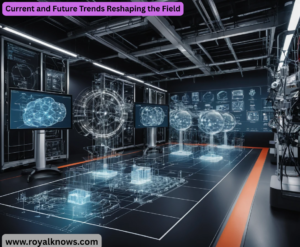
- Extended Reality (XR): Virtual Reality (VR) and Augmented Reality (AR) are immersive communication mediums that require immense IT processing power, high-bandwidth networks (5G), and cloud computing to render complex environments in real-time.
- Digital Twins: A virtual IT model of a physical object, system, or process (e.g., a factory, a city’s power grid). The physical and digital twins communicate data continuously to optimize performance, predict failures, and simulate scenarios.
The Security Imperative: Cybersecurity as a Communication Enabler
- Security is no longer just an IT afterthought; it’s a fundamental requirement for trustworthy communication.
- Zero Trust Architecture: operates on the principle “never trust, always verify.” It assumes no user or device, inside or outside the network, is trustworthy by default.
- End-to-End Encryption (E2EE): (e.g., in WhatsApp, Signal) ensures that a communication (message, call) can only be read by the sender and recipient, not even by the IT company providing the service. This protects the privacy of the communication content.
Edge Computing: Processing Data Where It’s Created
- Instead of sending all data from IoT devices or smartphones to a centralized cloud for processing, edge computing does the processing locally (“at the edge” of the network).
- Why? It reduces latency (delay). This is critical for communications that require instant response.
- Example: An autonomous car’s sensors must process data immediately to avoid an obstacle.
Quantum Computing (On the Horizon)
- This future technology promises to shatter current IT paradigms, with huge implications for communications.
- Threat: Could break most current encryption methods (e.g., RSA), jeopardizing the security of all digital communications.
- Opportunity: Quantum Key Distribution (QKD) could create theoretically unhackable communication channels, as any attempt to eavesdrop would disrupt the quantum state and be immediately detectable.
The Human and Societal Impact
- The convergence of Comms and IT is not just technical; it’s cultural and sociological.
- The Attention Economy: Our attention is the new scarce resource. Digital platforms (IT) are designed to capture and hold our attention through sophisticated communication strategies, leading to debates about screen time, social media addiction, and mental health.
- Misinformation and Disinformation: The speed and reach of digital communication allow false information to spread globally in minutes. IT tools like deepfakes (AI-generated synthetic media) make it incredibly difficult to distinguish truth from fiction, challenging the very basis of trustworthy communication.
- The Digital Divide: Access to modern IT and communication infrastructure is not equal. This creates a gap between those who have high-speed internet and the skills to use it and those who do not, affecting education, economic opportunity, and social participation.
 xentro6@gmail.com