


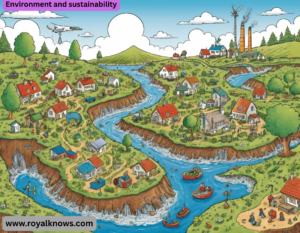
Environment and sustainability The environment encompasses Earth’s natural systems, including air, water, land, and ecosystems, which sustain life. Addressing climate change, pollution, and biodiversity loss through renewable energy, conservation, and circular economies is vital for long-term ecological balance and human well-being. (50 words)
Definition:
- Environment: The natural world, including ecosystems, biodiversity, climate, and resources that support life.
- Sustainability: Meeting present needs without compromising the ability of future generations to meet theirs (as defined by the Brundtland Report, 1987).
Key Environmental Challenges:
- Climate Change (global warming, extreme weather)
- Biodiversity Loss (species extinction, habitat destruction)
- Pollution (air, water, plastic waste)
- Deforestation (logging, agriculture expansion)
- Resource Depletion (overfishing, water scarcity, fossil fuels)
Pillars of Sustainability:
- Environmental – Protecting ecosystems, reducing carbon footprint.
- Social – Equity, health, education, and community well-being.
- Economic – Sustainable business practices, green jobs, circular economy.
Global Sustainability Efforts:
- Paris Agreement (2015): Limits global warming to <2°C (ideally 1.5°C).
- UN Sustainable Development Goals (SDGs): 17 goals (e.g., clean energy, zero hunger, climate action).
- Circular Economy: Reduce, reuse, recycle (vs. linear “take-make-waste”).
How Individuals Can Help:
- Reduce energy use (solar, LED lights).
- Minimize waste (recycling, composting).
- Support sustainable brands (fair trade, eco-friendly).
- Advocate for policy changes (carbon taxes, conservation laws).
Future Outlook:
- Renewable Energy Shift (solar, wind, hydrogen).
- Green Technology (EVs, carbon capture).
- Conservation & Restoration (reforestation, ocean protection).
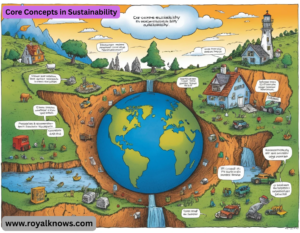
Core Concepts in Sustainability
A. The Triple Bottom Line (People, Planet, Profit)
- Environment and sustainability People (Social Equity): Fair wages, safe working conditions, community health.
- Planet (Environmental Health): Reducing emissions, protecting ecosystems.
- Profit (Economic Viability): Businesses must thrive without harming the other two.
B. Planetary Boundaries (Stockholm Resilience Centre)
- Nine limits we must not cross to avoid irreversible environmental damage:
- Climate Change
- Biodiversity Loss
- Nitrogen & Phosphorus Cycles (fertilizer overuse)
- Ocean Acidification
- Land Use Change (deforestation)
- Freshwater Depletion
- Ozone Depletion
Air Pollution (aerosols)
- Chemical Pollution (plastics, pesticides)
- We’ve already exceeded at least 6 of these.
C. Ecological Footprint vs. Biocapacity
- Ecological Footprint: Human demand on nature (carbon, food, water, land).
- Biocapacity: Earth’s ability to regenerate resources.
- Currently, humanity uses 1.7 Earths’ worth of resources annually (overshoot).
Major Environmental Crises
A. Climate Change
- Causes: CO₂ from fossil fuels, methane (livestock, landfills), deforestation.
- Effects: Rising temps, sea-level rise, extreme weather (hurricanes, droughts).
- Tipping Points: Amazon dieback, Arctic ice loss, coral reef collapse.
B. Biodiversity Loss (6th Mass Extinction)
- Current Rate: Species dying 1,000x faster than natural rate (IPBES).
- Causes: Habitat destruction, pollution, invasive species, climate change.
- Impact: Ecosystem collapse (e.g., bees dying → food crisis).
C. Pollution & Waste
- Plastic Waste: 8M+ tons enter oceans yearly; microplastics in human blood.
- Air Pollution: Kills ~7M/year (WHO); linked to coal, vehicles, industry.
- E-Waste: 50M+ tons/year (only 20% recycled).
D. Water Scarcity
- 2.2B people lack safe drinking water (UN).
- Causes: Overuse (agriculture 70%), pollution, climate change.
Solutions & Innovations
A. Energy Transition
- Renewables: Solar, wind, hydro (now cheaper than coal in most places).
- Nuclear & Hydrogen: Potential for zero-carbon energy.
- Carbon Capture (CCUS): Tech to remove CO₂ from air (still expensive).
B. Circular Economy (Zero Waste)
- Reuse/Recycle: Cradle-to-cradle design (e.g., recycled plastics → new products).
- Regenerative Agriculture: Soil health, no-till farming, agroforestry.
- Corporate Shifts: Patagonia (recycling clothes), Tesla (EVs + solar).
C. Policy & Global Agreements
- Paris Agreement (2015): 196 nations pledged net-zero by 2050-2070.
- EU Green Deal: Carbon-neutral by 2050, plastic bans.
- Carbon Pricing: Taxing polluters (Canada, EU, California).
D. Individual Actions That Matter
- Environment and sustainability Diet: Reduce meat (beef = highest CO₂).
- Transport: Walk, bike, EV, public transit.
- Consumption: Buy less, choose sustainable brands.
- Voting: Support green policies (renewables, conservation).
Future Challenges & Opportunities
- Tech Hope: Lab-grown meat, AI for conservation, fusion energy.
- Risks: Greenwashing, slow policy action, inequality in climate impacts.
- Youth Movements: Fridays for Future (Greta Thunberg), Sunrise Movement.
Advanced Environmental Science
A. Climate Science Deep Dive
- Greenhouse Gases (GHGs):
- CO₂ (fossil fuels, deforestation)
- Methane (CH₄) (livestock, landfills, 25x more potent than CO₂)
- Nitrous Oxide (N₂O) (fertilizers, industry)
- Feedback Loops Accelerating Warming:
- Arctic Permafrost Thaw → Releases methane.
- Amazon Rainforest Dieback → Less CO₂ absorption.
- Albedo Effect Loss (melting ice → less sunlight reflection).
B. Biodiversity & Ecosystem Collapse
- Keystone Species: Loss of wolves, bees, coral reefs disrupts entire ecosystems.
Deforestation Hotspots:
- Amazon (cattle, soy)
- Indonesia (palm oil)
- Congo Basin (logging)
- Marine Threats: Overfishing, acidification, deep-sea mining.
Economics & Sustainability
A. The Cost of Inaction
- World Economic Forum: Climate disasters will cost $23T by 2050.
- Climate Refugees: 1.2B may migrate by 2050 due to droughts/floods.
B. Green Growth Opportunities
- Renewable Energy Jobs: Solar installers (+50% growth by 2030).
- Carbon Markets: Companies trade emission credits (EU ETS = $800B+ market).
- ESG Investing: $40T+ in assets now follow environmental criteria.
C. Degrowth vs. Green Growth Debate
- Degrowth: Reduce consumption, GDP focus.
- Green Growth: Tech + policy decouples growth from emissions (e.g., Denmark’s wind energy).
National Policies Working
- Sweden: Carbon tax ($137/ton), 99% waste recycled.
- Costa Rica: 98% renewable energy, reforestation.
- China: World’s largest EV market (50% of global sales).
B. Legal Rights for Nature
- Ecuador: First constitution granting nature rights (2008).
- New Zealand: Whanganui River has legal personhood.
Cutting-Edge Sustainability Tech
A. Energy Breakthroughs
- Environment and sustainability Nuclear Fusion: ITER project (potential limitless clean energy).
- Green Hydrogen: Made via renewables (Germany investing €9B).
- Perovskite Solar Cells: Cheaper, more efficient than silicon.
B. Food & Agriculture Innovations
- Lab-Grown Meat: 90% less CO₂ than beef (Singapore approved).
- Precision Fermentation: Brewing proteins (e.g., Perfect Day milk).
- Vertical Farming: 95% less water (AeroFarms, Plenty).
Grassroots Movements & Activism
A. Key Organizations
- Extinction Rebellion: Non-violent civil disobedience.
- Sunrise Movement: U.S. youth pushing Green New Deal.
- The Ocean Cleanup: Removing plastic from oceans.
B. Digital Activism Tools
- Climate TRACE: AI tracks emissions in real-time.
- Ecosia: Search engine planting trees.
C. How to Get Involved
- Join local climate strikes.
- Divest from fossil fuels (check your bank/pension).
- Pressure politicians (write, protest, vote).
The Future: 2030 & Beyond
Optimistic Scenario
- Net-Zero by 2050: Renewables dominate, carbon priced globally.
Pessimistic Scenario
- +2.5°C by 2100: Worsening disasters, mass migrations.
- Resource Wars: Water/food conflicts escalate.
What’s Needed Now?
- System Change (not just recycling).
- Corporate Accountability (end fossil fuel subsidies).
- Climate Justice (rich nations pay for damage).
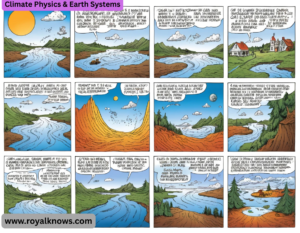
Climate Physics & Earth Systems
A. The Carbon Cycle Out of Balance
- Environment and sustainability Natural Flux: 750 Gt CO₂ exchanged annually between oceans, land, and atmosphere.
- Human Disruption: +37 Gt CO₂/year from fossil fuels + 5 Gt from land use.
- Sinks Saturation: Oceans absorb 30% of emissions → acidification (pH drop of 0.1 since 1850).
Geopolitics of Resources
B. Water Wars: Current Conflicts
- Nile River: Ethiopia’s GERD dam vs. Egypt.
- Indus River: India-Pakistan tensions.
- Colorado River: 7 U.S. states over-allocated.
C. Climate Justice Litigation
- Urgenda Case (Netherlands): Courts ordered 25% emissions cut by 2020.
- Held v. Montana: Youth won right to clean environment.
4. Next-Gen Technologies
B. AI for Sustainability
- Wildlife Protection: SMART patrols predict poaching.
- Precision Agriculture: IBM’s Watson reduces water use 30%.
C. Space-Based Solutions
- Solar Power Satellites: Japan testing 1GW beam by 2030.
- Asteroid Mining: Could reduce terrestrial resource extraction.
 xentro6@gmail.com